




The Hidden Tax: Why Scaling Your Business Often Means Scaling Waste
The Hidden Tax
Why Scaling Your Business Often Means Scaling Waste
Quick Summary: Operational waste is an invisible drain on profitability that grows alongside your business. By identifying “Non-Value-Added” activities and using the PROFIT-ABILITY Framework®, business owners can stop chasing sales to cover errors and inefficiencies and instead engineer a more efficient, high-performance engine for growth.
The Scaling Trap: More Revenue, More “Air”
Most business owners believe that if they just land that next big contract, their problems will vanish. But there is a silent predator in the gap between your finance team and your shop floor.
In my early days driving a dustcart around Northamptonshire, waste was visible—you could see it, smell it, and physically remove it. Today, as an Operational Profit Architect, I see the same thing in £10m+ businesses, but it’s hidden in spreadsheets, idle CNC machines, and “storing air” in massive warehouses.
As a business grows, the “hand-crafted” processes that worked at £1m turnover become the bottlenecks at £10m. This is the Operational Waste Tax. The bigger the ship, the more drag it creates if the hull isn’t clean.
The Profit-Ability Math: The Sales Equivalent
At Neuvantage, we don’t just offer “advice”; we calculate the cost of your inefficiency.
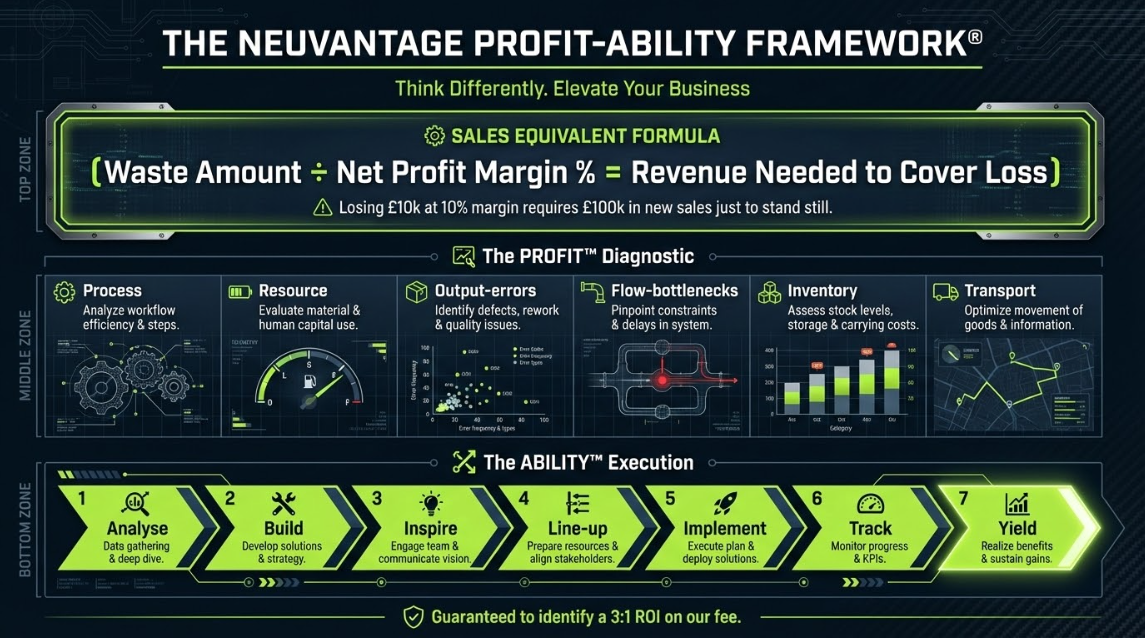
If your business has £50,000 in operational waste (errors, rework, or waiting) and you operate on a 10% net margin, you don’t just lose £50,000.
The Math: £50,000 / 0.10 = £500,000.
You are forced to generate half a million pounds in new sales just to stand still and pay for the mistakes you’ve already made. We shift your focus from chasing sales to cover errors to eliminating the errors themselves.
The Keys to the Engine: Economy, Efficiency, and Effectiveness
Total profit isn’t just about Economy (buying things cheap). It requires:
- Efficiency: Doing things right (minimising input for the same output).
- Effectiveness: Doing the right things (ensuring the output actually drives the KPI).
For start-ups, the best way to start on the right foot is the “Electric Bike” Principle: use technology (AI/Automation) as your battery to go faster, but ensure you have a human rider to steer and brake. As you build your business adapt, keep everything logged and filed, put everything in writing so you can easily teach it as you grow. Implement the Three-Strike Rule: if you do a manual task three times, automate it.
The Neuvantage PROFIT-ABILITY Framework®
We use a proprietary 13-step engine to transform your business:
The PROFIT™ Phase (Diagnosis)
- Process (Inefficient steps or “non value add” tasks)
- Resource (Underutilised talent, assets or tech)
- Output-errors (Rework and scrap)
- Flow-bottlenecks (Where things stop, on the ‘shopfloor’ or in the office)
- Inventory (Cash tied up in stock)
- Transport (Moving things too much)
The ABILITY™ Phase (Execution)
- Analyse (Root cause data)
- Build (The bespoke fix)
- Inspire (Team buy-in)
- Line-up (Resource staging)
- Implement (Precision deployment)
- Track (Real-time KPIs)
- Yield (Documented 3:1 ROI)
Stop Storing Air. Start Building Profit.
We cost money, but we pay for ourselves. If you are ready to stop recording history and start engineering future cash flow, let’s talk.