






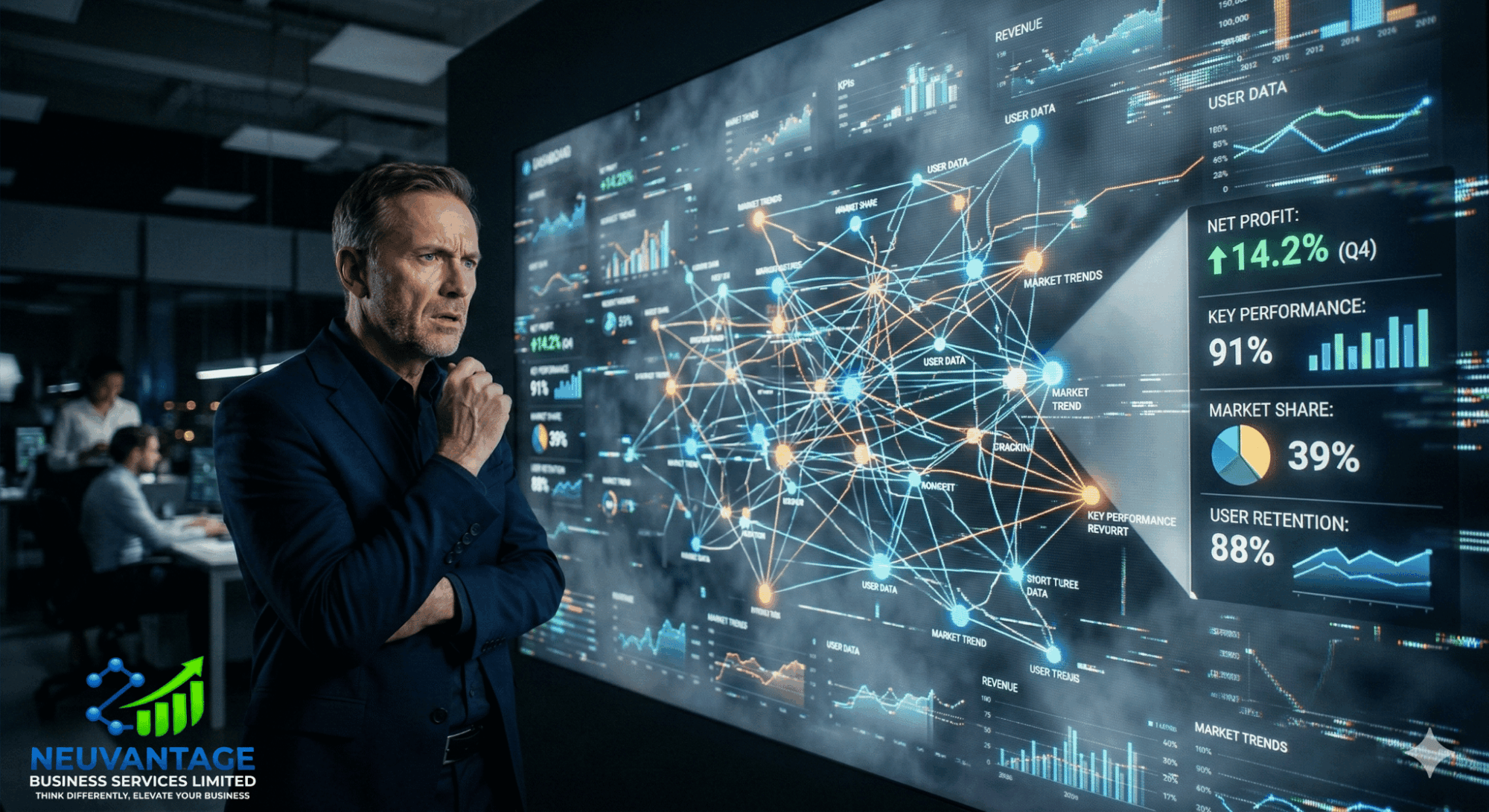
WHY YOUR ‘SMART’ DASHBOARD IS ACTUALLY DRIVING YOUR BUSINESS BLIND
Quick Summary:
* Most businesses drown in data, mistaking activity for progress.
* Your current dashboards are likely a misdirection, hiding the true drivers of profit and efficiency.
* It’s time to stop measuring what’s easy and start measuring what genuinely impacts your bottom line.
Every business leader believes they understand their operation. They pore over reports, scrutinise charts, and make decisions based on what their systems present. But what if the very tools designed to grant clarity are, in fact, the most sophisticated form of self-deception, actively steering your strategic direction into a fog of irrelevant or incorrect data? What if the numbers you trust implicitly are merely reflecting symptoms, not causes, and obscuring the truly critical insights needed to thrive in an increasingly challenging market?
This isn’t a theoretical problem; it’s a costly reality. You’re presented with an array of figures daily, weekly, monthly. Revenue, customer counts, website visits – all appear to paint a picture of control. Yet, beneath this veneer of data literacy, operational inefficiencies fester, strategic missteps occur, data errors happen and profitability erodes. The harsh truth is, many businesses are making significant decisions based on metrics that, at best, offer superficial reassurance, and at worst, actively mislead.
Consider the impending pressure on UK businesses. Around half (48%) expect to raise their selling prices by June 2026 due to higher payroll expenses from National Insurance and minimum wage changes in April 2025. If your internal reporting can’t accurately pinpoint your true cost base, your operational inefficiencies, or your most profitable customer segments, how can you possibly set prices competitively and maintain margins in the face of such significant external cost increases? The answer is simple: you can’t, not effectively. You’ll either price yourself out of the market or erode your own profitability without understanding why.
The Illusion of Activity Versus Actual Impact
Many organisations fall prey to the illusion that constant activity equates to progress. Their dashboards contain Key Performance Indicators (KPIs) that track busyness: the number of customer interactions, the volume of emails sent, the project milestones achieved. While these metrics reflect effort, they often fail to correlate with actual business impact. Businesses meticulously measure the output of their cogs, but rarely the efficiency or value creation of the entire machine.
The danger here is profound. When leaders reward or focus solely on activity-based metrics, they inadvertently incentivise busyness over genuine value creation. Teams become experts at generating impressive-looking activity reports, rather than delivering tangible, profitable outcomes. This leads to a false sense of accomplishment, where everyone appears to be working hard, yet the business struggles with stagnant growth, declining margins, loss of market share or persistent operational friction. The cost isn’t just wasted time; it’s the misdirection of entire departments, the diversion of capital, and the squandering of potential.
True impact KPIs, by contrast, focus on outcomes: profit per client, customer lifetime value, conversion rates, or cost of goods sold variance. These are the numbers that directly reflect the health and strategic direction of the business, forcing a critical examination of processes and resource allocation. Without this fundamental shift in what is measured, businesses remain trapped in a cycle of perceived productivity that masks genuine inefficiency.
Why Your Current Metrics Are Misleading You
The prevalence of ‘vanity metrics’ is a critical flaw in many business dashboards. These are figures that look impressive but provide little, if any, actionable insight for strategic decision-making. Think of a marketing dashboard boasting millions of impressions without any corresponding analysis of lead quality or conversion to sales. Such metrics inflate egos but deflate genuine understanding of market effectiveness.
Frequently, dashboards are constructed by individuals far removed from the sharp end of operations. IT departments or junior analysts, while technically proficient, may lack the deep operational understanding required to identify truly meaningful indicators. This results in systems that measure what’s easy to extract from databases, rather than what’s critical to business success. The result is data presented without the necessary context – a number in isolation provides no value. Is 10% growth good or bad? Without knowing the market, the target, or the cost of achieving it, the figure is meaningless.
Added to this, a significant issue lies in the over-reliance on lagging indicators. These tell you what *has* happened – past sales, historical profits, completed projects. While useful for post-mortem analysis, they offer little foresight. Effective leadership demands leading indicators – metrics that predict future performance, such as pipeline velocity, customer sentiment, or employee engagement. Without this forward-looking perspective, businesses are constantly reacting to events rather than proactively shaping their future, always a step behind the market and their competition. This fragmented view, often compounded by departmental silos, means no single dashboard truly reflects the holistic health or potential of the entire enterprise.
The Steep Cost of Operational Blindness: Missed Opportunities and Eroding Profitability
Operational blindness, stemming from misleading metrics, carries a steep price tag. When you don’t truly understand where your business is haemorrhaging resources or where its real profit centres lie, profitability inevitably erodes. Inefficient processes become ingrained, costs escalate unchecked, and vital capital is misallocated to underperforming areas. Imagine pouring resources into a customer segment that, according to your ‘profitability’ metric, looks promising, only for deeper analysis to reveal high servicing costs that negate any perceived revenue gain. This isn’t just inefficiency; it’s an active destruction of shareholder value.
Beyond direct financial losses, operational blindness leads to missed strategic opportunities. Without accurate insight into market shifts, emerging competitor advantages, or changing customer behaviours, businesses remain stagnant. Decisions are made on gut feeling or historical precedent, rather than data-driven foresight. This means slow reaction times to critical market changes, losing out on innovative product developments, or failing to capitalise on new customer demographics. In a dynamic economy, a delay of even a few months can cost millions in lost revenue or market share.
The biggest cost, however, is the opportunity cost – the profit, growth, and stability that could have been achieved if only leaders had possessed accurate, actionable insight. It’s the cost of not knowing where to invest, where to cut, or how to pivot. This blindness creates a culture of reactive ‘firefighting,’ where management is constantly addressing symptoms rather than tackling root causes. It’s a never-ending cycle of crisis management that distracts from strategic growth and improvement, leaving businesses vulnerable to external pressures, such as the widely anticipated payroll expense increases that will challenge UK businesses over the next couple of years. Without precise internal measurement, how can any business realistically navigate these external financial headwinds?
Crafting True Insight: The ‘What Matters’ Filter
The pathway to genuine insight begins by ruthlessly challenging every metric currently on your dashboard. Start not with the data you have, but with the strategic objectives of your business. What are you trying to achieve? Increased profitability? Market dominance? Enhanced customer satisfaction? Once these overarching goals are clear, then and only then can you identify the critical few KPIs that genuinely measure progress towards them. This involves a rigorous ‘what matters’ filter, ensuring every metric serves a direct, actionable purpose.
This process cannot be relegated solely to the finance department. It requires cross-functional collaboration – bringing together operational leaders, sales, marketing, and customer service to collectively define what success looks like from every angle. This holistic perspective ensures that chosen KPIs are relevant, understood, and accepted across the entire organisation. Furthermore, each KPI must be actionable; if a metric doesn’t lead to a specific decision or a change in behaviour, it merely adds noise to your reporting. Focus on the ‘critical few’ rather than the ‘trivial many’ – a dashboard overloaded with irrelevant data is as unhelpful as having no data at all.
Effective KPIs provide context. They are benchmarked against industry standards, tracked as trends over time, and compared against clearly defined targets. This allows leaders to move beyond simply seeing a number to understanding its significance and implications. The ability to ‘drill down’ from high-level summaries to underlying granular data is also paramount. A dashboard should offer a top-level snapshot but empower users to investigate anomalies and identify root causes, fostering a culture of informed inquiry rather than superficial acceptance.
From Data Overload to Decisive, Profitable Action
Moving from a state of data overload to one of decisive, profitable action is the ultimate goal of effective KPI and dashboard implementation. It transforms your reporting from a historical archive into a living, breathing decision-making engine. This shift empowers leadership to move beyond constant reactive ‘firefighting’ and embrace proactive strategic planning, anticipating challenges and capitalising on opportunities before they fully materialise.
For this transformation to occur, accurate and timely insight must become embedded in the daily operational rhythm of the business. Leaders shouldn’t just glance at a dashboard; they should actively engage with it, interrogate the data, and use it as the foundation for daily, weekly, and monthly strategic discussions. This demands a culture where data is trusted, challenged, and used to inform every significant decision, from adjusting pricing strategies in response to rising payroll expenses to optimising supply chain logistics.
True effectiveness also relies on the seamless integration of data sources. Sales, marketing, finance, and operations often operate within their own data silos. A truly effective dashboard unifies these streams, providing a single, coherent view of the business. This integrated perspective reveals interdependencies and opportunities that isolated departmental reports would inevitably miss. Ultimately, the continuous improvement loop – measure, analyse, act, review, and refine – becomes the bedrock of your operational strategy, ensuring that your business is not just seeing the present, but actively shaping its profitable future. This level of insight translates directly into enhanced profitability, increased efficiency, and a truly effective organisation ready to face any market challenge.
The truth is that most businesses are operating with blindfolds on, trusting in dashboards that tell them comforting fictions rather than inconvenient truths. The choice is stark: continue making decisions in the dark, or demand the accurate, actionable insight that will truly drive your business forward.
Which path will you choose?
Book a zero-pressure strategy call here: https://calendar. app. google/HwHP1shXki16YULGA