





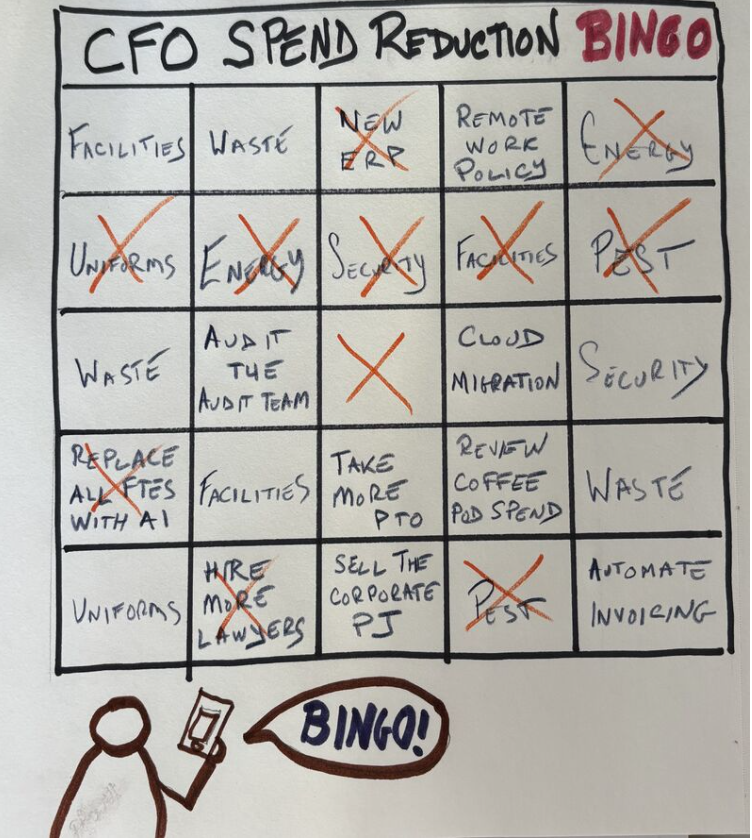
CFO Spend Reduction Bingo: Why Cost Cutting Alone No Longer Delivers Sustainable Results
The Pattern Every CFO Recognises
82% of companies failed to meet their cost reduction targets in 2024—up from 72% the previous year. For CFOs and business owners, this statistic reflects a familiar rhythm: when margins come under pressure, the same initiatives resurface. Energy reviews, office costs, cloud optimisation, automation, policy tightening. Boxes are ticked, savings are reported, and yet twelve months later the pressure returns.
This cycle is often described informally as “Spend Reduction Bingo.”
Well-intentioned, disciplined, but increasingly ineffective.
Why Traditional Cost-Cutting Keeps Falling Short
The challenge is not financial rigour. It is the structure behind the decisions.
Savings focus on what is visible, not what is material
Energy, facilities and discretionary spend are easy to target, but they rarely deliver sustained margin improvement. Any gains are quickly absorbed by inflation, growth or operational complexity. With inflation climbing to 3.8% in 2025, the highest point since January 2024, cost savings are eroded faster than ever. A 5% one-time reduction can be completely absorbed within 18 months simply through inflationary pressure, forcing CFOs back to the same cost-cutting playbook.
Decisions are reactive rather than systemic
Cost initiatives are typically launched in response to short-term pressure. Categories are reviewed individually, often without a consolidated view of indirect spend, supplier fragmentation or market benchmarks. Research shows that only 11% of organisations sustain cost reductions beyond three years when they treat cost reduction as a one-time event rather than an embedded system.
Cost cutting creates friction inside the business
Pure cost reduction is often perceived as constraint. It leads to workarounds, decentralised buying and loss of control. Without centralised visibility, the same item can be purchased at five different prices from five different suppliers. Decentralised models reduce negotiating leverage as spend is spread too thinly. Over time, the organisation becomes less efficient, not more.
Where Sustainable Margin Improvement is Actually Found
In many organisations, the largest untapped opportunity sits in indirect spend.
Categories such as parcel delivery, packaging, third-party logistics (3PL), consumables and business services often represent 25-40% of total expenditure, yet receive limited strategic attention. Spend is fragmented, contracts vary by site or team, and pricing is rarely benchmarked at scale. Fragmented purchasing creates a ‘long tail’ of suppliers that can account for up to 30% of total spending.
The mathematics are straightforward: individually, businesses have limited negotiating power. Collectively, the picture changes. Studies show that consolidating fragmented spending generates 10-20% savings on those goods and services—without compromising quality or service. For instance, right-sizing packaging alone can reduce shipping costs by 20%, whilst strategic 3PL partnerships deliver 10-30% savings through consolidated rates and optimised logistics strategies.
Moving from Cost Cutting to Margin Recovery
Sustainable improvement comes from replacing isolated initiatives with a repeatable commercial model that doesn’t depend on repeated interventions. The fundamental flaw in traditional cost-cutting is treating it as an event rather than a system. Without embedded structures for ongoing visibility and control, costs inevitably creep back—often within 12-24 months.
Effective margin recovery requires:
-
Consolidated purchasing volumes – aggregating demand to build genuine negotiating leverage
-
Standardised supplier terms – eliminating the long tail of fragmented, inefficient supplier relationships
-
Market-tested pricing and surcharge structures – ensuring rates reflect genuine market conditions, not legacy agreements
-
Ongoing governance rather than one-off reviews – embedding cost management into day-to-day operations
-
Minimal operational disruption – delivering results without requiring major internal transformation
This approach does not rely on repeated interventions. It embeds margin recovery into the fabric of how the business operates.
One-time cost initiatives have their place—particularly in crisis situations requiring immediate cash preservation. But for sustained margin improvement, structural approaches consistently outperform repeated interventions.
How Buying Groups Deliver Sustainable Results
Group Purchasing Organisations work by aggregating demand across multiple businesses to access margins and terms that individual organisations cannot secure alone. Typical savings across procurement categories range from 10-25% annually, with some specialists in specific categories delivering savings of up to 30%.
Unlike enterprise-wide procurement transformations that can take 12-18 months, participation typically delivers measurable savings within 60-90 days with minimal internal resources required.
By joining a buying group model focused on under-managed indirect spend categories, businesses gain access to:
-
Pre-negotiated, market-aligned supplier terms – eliminating the time and expertise required for individual negotiations
-
Improved pricing leverage without individual scale requirements – accessing the savings of larger organisations
-
Greater cost visibility and control – understanding where money is spent and why
-
Recurring, defensible savings rather than short-term reductions – building a permanent improvement to the profit and loss statement
The model complements existing finance and procurement functions without replacing them. Internal teams maintain full control; the buying group simply amplifies negotiating power and provides ongoing market intelligence.
The Question for CFOs in 2025
For many CFOs and business owners, the question is no longer how to cut costs harder, but how to recover margin in a way that is sustainable, controlled and repeatable.
Sometimes the most effective change is not another initiative, but a better structure behind the spend.
About Procure Partners
Procure Partners works with businesses through a buying group model focused on optimising under-managed indirect spend categories. By aggregating demand across multiple organisations, members gain access to market-aligned supplier terms, improved pricing leverage and recurring, defensible savings—without the disruption and effort of traditional cost reduction programmes.
Interested in Learning More?
If you’d like to explore how a buying group approach could work for your organisation, we’d welcome a conversation.
Contact Procure Partners:
Name: Andrei Vortolomei
Email: av@procurepartners.co.uk
Phone: +44 (0) 7360 211 027
We typically conduct initial conversations in 20-30 minutes and can often identify quick wins specific to your spend profile within that time.