






UK BUSINESSES GRAPPLE WITH INEFFICIENCY AS PROFIT PRESSURES MOUNT: A SHOP-FLOOR PERSPECTIVE
At a Glance:
* Many UK businesses are contending with unseen inefficiencies on the shop floor, directly impacting profitability.
* Traditional approaches often miss opportunities for operational improvements, focusing solely on historical data.
* A hands-on, forward-looking strategy is vital for businesses to achieve lasting profitability and effectiveness.
Across the United Kingdom, boardrooms are increasingly focused on navigating a complex economic landscape where cost pressures and market volatility are persistent challenges. Yet, the real battle for profitability is often won or lost not in quarterly reports, but on the very shop floors and in the operational hubs of businesses, where daily inefficiencies can silently erode margins. Neuvantage, a specialist in financial performance and operational excellence, argues that many UK businesses, particularly those that have scaled rapidly, are inadvertently operating with significant internal waste, a challenge exacerbated by broader economic headwinds. By 2026, a striking 81% of UK executives plan to raise prices moderately or significantly, with a considerable 72% expecting high energy costs to negatively impact their profits, underscoring the urgent need for a robust internal engine.
The prevalent focus on historical financial data often leads businesses to overlook the granular, day-to-day operational misalignments that, over time, amount to substantial profit haemorrhage. While traditional accountants meticulously report on the past, they rarely venture beyond the ledger to diagnose the root causes of inefficiency on the factory floor, in the warehouse, or within complex service delivery chains. This creates a critical void, leaving chief executives and managing directors grappling with profitability concerns without a clear pathway to operational remedies. It is precisely this gap that forward-thinking organisations must address to ensure not just survival, but sustained growth in a challenging market.
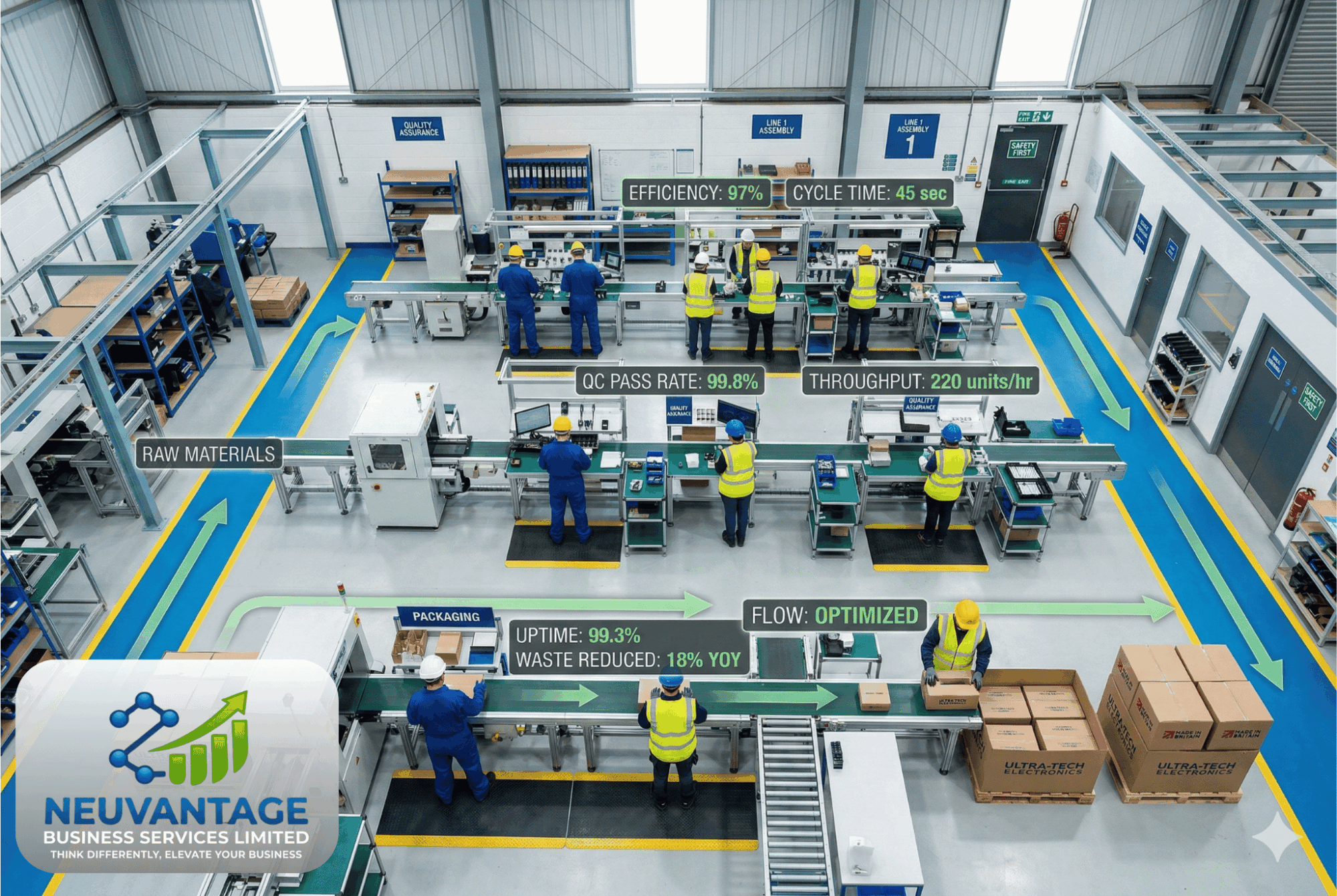
Consider the manufacturing plant, for instance, a bustling hub of activity where raw materials transform into finished goods. Here, the hum of machinery can often mask underlying issues: excessive idle time between production stages, unnecessary movement of goods, frequent rework due to quality control lapses, or vast quantities of inventory sitting stagnant, tying up crucial capital. These are not merely ‘operational quirks’; they are direct drains on profitability. A common scenario involves production lines halted because a component is not readily available, or a delivery fleet returning half-empty due to suboptimal routing. These issues, while seemingly minor in isolation, compound daily, eating into labour hours, increasing utility consumption, and delaying market entry, ultimately affecting the bottom line.
Neuvantage’s distinctive approach begins where others typically conclude their analysis – on the shop floor. Our experts do not merely scrutinise spreadsheets; they immerse themselves in the operational environment, observing processes firsthand. This deep engagement allows for the identification of inefficiencies that are invisible from a boardroom vantage point. We might discover that a specific machine operator consistently waits for materials, or that a critical component is frequently damaged during transit between departments, or that the packaging process is riddled with unnecessary steps. These real-world observations are critical for understanding how operational bottlenecks manifest and how they directly impede the flow of value through the business. This hands-on method bridges the divide between financial reporting and operational reality, providing a comprehensive view of how costs are actually incurred and how they can be effectively managed.
The challenge for many businesses that have scaled significantly is that their processes, once lean and agile in their nascent stages, become bloated and inefficient as growth occurs. What worked with a team of ten often collapses under the weight of a hundred. This results in heads of department and directors constantly ‘fire-fighting’ – reacting to daily crises, from unexpected equipment breakdowns to missed delivery deadlines, rather than proactively optimising their operations. This reactive stance perpetuates a cycle of inefficiency, as attention is diverted from strategic improvements to merely keeping the wheels turning. The absence of accurate, real-time operational insights, often obscured by patchwork spreadsheets and disconnected data systems, further entrenches this problem, preventing sound strategic decisions and hindering genuine progress towards efficiency and effectiveness.
Our methodology involves becoming an integral part of the client’s team, working alongside them to implement solutions rather than simply presenting recommendations and then departing. This ensures that the identified improvements are not just theoretical but are embedded within the operational fabric of the business. By understanding the intricate details of processes, from initial material procurement to final product delivery, we can pinpoint areas where waste is prevalent – whether it be wasted motion, overproduction, defects, or underutilised skills. This detailed, ‘shop-floor to boardroom’ perspective allows us to craft tailored strategies that reduce operational expenditure, enhance throughput, and improve overall product or service quality, all contributing directly to improved profitability. This deep partnership approach ensures that knowledge transfer occurs, empowering internal teams to sustain these improvements long after our direct involvement.
For instance, by meticulously analysing a production line’s workflow, we might uncover that a seemingly minor reordering of tasks or a small investment in a specific piece of equipment could eliminate hours of waiting time daily, dramatically increasing output without additional labour costs. Similarly, rationalising inventory levels, based on robust forecasting rather than reactive purchasing, frees up significant working capital. These are not abstract concepts; they are tangible improvements that directly translate into a healthier balance sheet and increased operational capacity. This pragmatic application of expertise is what differentiates our work, moving beyond theoretical consultation to practical, deliverable results that resonate across every level of the organisation, from the production operative to the chief executive officer.
Added to that, the capacity to implement effective pricing strategies, whether optimising for volume or profit margins, is severely hampered without a precise understanding of true operational costs. Businesses cannot make informed decisions about pricing adjustments if they are unaware of the exact cost of production, delivery, and overheads associated with each unit. Similarly, robust cashflow management and accurate budgeting and forecasting become aspirational rather than achievable without transparent, forward-looking operational data. Neuvantage provides the tools and expertise to implement rigorous KPIs and dashboards, ensuring that businesses are measuring what truly matters, providing accurate insight that enables them to make sound strategic decisions, thereby transforming their profitability, efficiency, and effectiveness. This is about building a business that is not only profitable today but is also resilient and adaptable for tomorrow, capable of thriving amidst economic pressures and market shifts.
As UK businesses brace for sustained high energy costs and the imperative to manage pricing effectively, the need to eliminate internal inefficiency has never been more pressing. The future profitability of many organisations hinges not on external market forces alone, but on their internal capacity to optimise every facet of their operations. Ignoring the silent erosion of profit on the shop floor is no longer a viable option; it demands a proactive, informed, and hands-on approach. Are you confident that your operational engine is running at peak efficiency, or are hidden inefficiencies silently draining your profits?